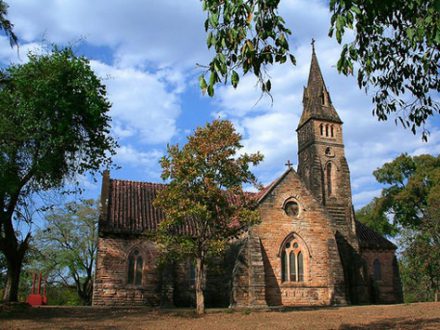
The Catholic Church of Pachmarhi
The Catholic Church of Pachmarhi was built in 1892 and stands as one of the finest examples of colonial-era ecclesiastical architecture in Central India. It is a perfect blend of French and Irish architectural styles — a testament to the European influence that shaped Pachmarhi during the British colonial period.
The church's most celebrated feature is its Belgian stained-glass windows, which give a rare and enchanting view to the interior. When sunlight filters through these coloured glass panels, the interior is bathed in an extraordinary kaleidoscope of light — an experience that must be seen to be believed.
Attached to the church is a cemetery with graves dating as far back as 1859 — even predating the church building itself, suggesting that a place of worship existed here earlier. The cemetery contains the graves of British officers, soldiers, and civilians who lived and died in Pachmarhi during the colonial era. Walking through the cemetery is a deeply atmospheric experience, offering a window into the lives of those who first discovered and developed this hill station.
The church remains an active place of worship and continues to serve the local Christian community of Pachmarhi. Its serene setting amidst the green hills makes it one of the most photographed buildings in the hill station.
Visitor Tips
- Dress modestly when visiting this active place of worship
- Best time to visit: morning light enhances the stained-glass colours inside
- The cemetery is open to respectful visitors — a fascinating historical record
- Photography permitted outside; ask permission before photographing inside
- Combine with other colonial-era heritage sites for a historical tour of Pachmarhi